


By Ross A. Cusic, O.D., F.I.A.L.V.S.
Seattle Low Vision | Kirkland, Washington
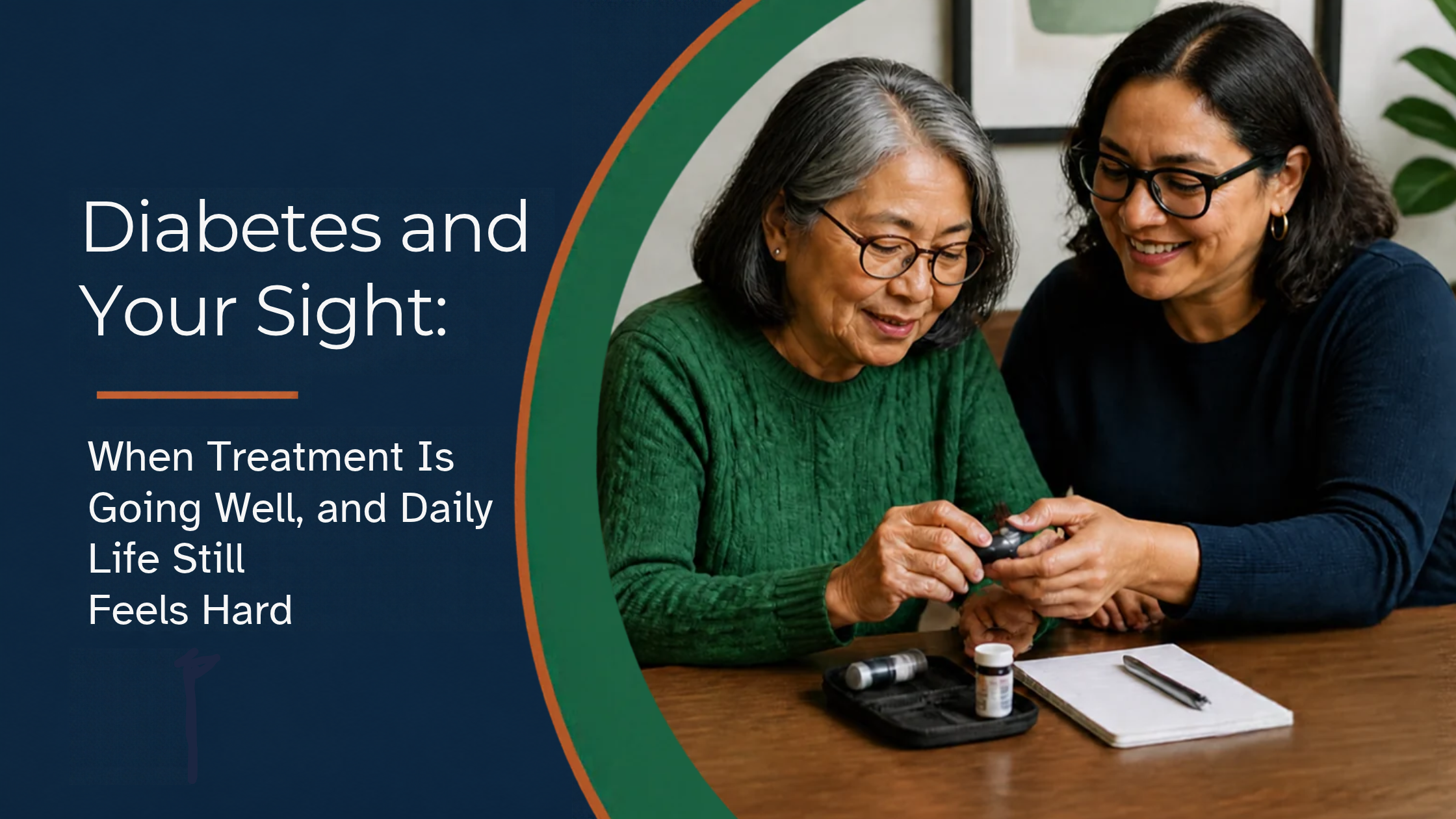
November is Diabetic Eye Disease Awareness Month, so this is the month I end up talking most about diabetes at Seattle Low Vision. But the conversation I have is usually not the one people expect.
A man came into my office a few months ago with an A1c his doctor was proud of and retina scans that had been stable for two years. He sat down and said, “So if everything is going so well, why can’t I read the numbers on my insulin pen?”
That sentence sums up diabetic retinopathy for a lot of people in Washington. Your medical care is working. Your eye doctor is doing exactly what they should. And your day-to-day life has still gotten smaller because the part of the retina that does your fine-detail work has been damaged, and damage doesn’t always show up as “things got worse” on a chart.
What Diabetic Retinopathy Actually Does to the Way You See
Background diabetic retinopathy from years of elevated blood sugar damages the small blood vessels that feed the retina. The result is often not total blindness. It is patchy, uneven vision. A blurry or blank place near the center of your gaze. Numbers that vanish. Contrast that disappears, so a dark blue sock and a black sock look identical. Glare that turns a phone screen into a white rectangle.
People describe it to me as “my eyes are tired” or “the light is bad in here.” Often it is not the light. It is the retina picking up less fine detail than it used to.
“Stable” and “I Can’t Read My Mail” Can Both Be True
A retina specialist’s job is to protect the structure of your eye and slow progression. That is exactly the right job, and I am grateful for the ophthalmologists and retina surgeons I work alongside in the Seattle area. Their measurements answer the question, “Is the disease getting worse?”
They are not designed to answer, “Can this person still match their pills to the right day of the week?”
That second question is where low vision care comes in. It does not replace anything your eye doctor is doing. It fills the gap between a good clinical result and a life that still feels like yours.
What I Look For in a Low Vision Evaluation
I start by asking what you want to do that you have stopped doing. Not what is medically possible in general. What stopped for you.
For people with diabetic retinopathy, the answers are strikingly consistent:
– Reading medication labels, insulin dosing, and glucose meter screens
– Seeing food on a plate, especially portions and color
– Reading mail, bills, and bank statements
– Driving at dusk or in rain
– Recognizing faces across a room
Then I measure how you use the vision you have, in the lighting you actually live in, at the distances your real tasks happen. Diabetes adds a layer here, because vision can fluctuate with blood sugar, and because retinopathy often comes with cataracts or macular edema that change the picture.
Matching Glasses and Tools to Your Real Tasks
There is no single answer for diabetic retinopathy, and anyone who tells you otherwise is selling something. What I prescribe depends on what you told me matters.
Some people do best with high-add prismatic reading glasses for close, sustained work like dosing medication or reading a letter from a grandchild. Others need hand-held or standing magnifiers in the kitchen, where both hands are busy. Absorptive lenses often help more than people expect, because they cut glare and boost contrast, which is where diabetic vision struggles most. Some patients benefit from side-vision awareness glasses if they have lost peripheral field. And when distance vision is the concern, bioptic telescope glasses can sometimes open the door to driving again, within the rules Washington sets.
Working With Your Care Team, Not Around It
If you have diabetic retinopathy, you should keep your retina specialist and your primary care doctor. You should also keep your regular optometrist, and I am happy to point people to Optical Images for routine exams. My role is to add the part that is missing: figuring out how to make the vision you have work better for the specific things you want to keep doing.
That is not a cure, and I will never tell you it is. It is function. It is confidence. It is being able to do the small things that make a day feel normal.
If you have been told your eyes are stable and you are still struggling, those two things can both be true. It is worth a conversation.
Call Seattle Low Vision at (425) 823-2020 for a free low vision phone consultation with me, Dr. Ross Cusic. We will talk about what has changed, what you want back, and whether low vision care has something to offer you. There is no pressure, and there is no charge for that first call.