


By Dr. Ross Cusic
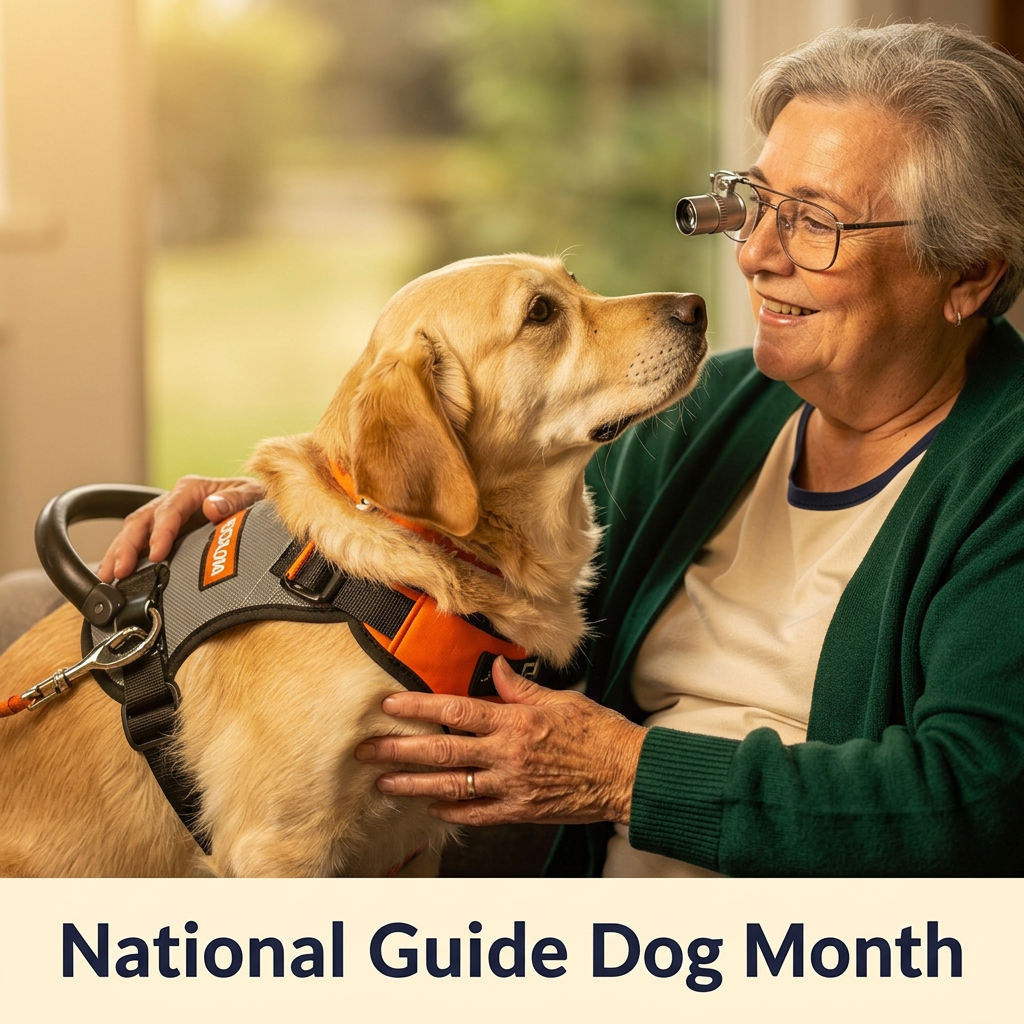
September is National Guide Dog Month, and it’s one of my favorite times of year to talk with patients about something I care deeply about: helping people with vision loss stay independent, confident, and connected to the life they love.
As a low vision specialist and clinical director at Seattle Low Vision, I’ve spent my career working with people throughout Washington, living with significant vision loss. Some of my patients use a guide dog, sometimes still called a “seeing eye dog,” in their daily lives. Others use a white cane, magnification, or specialized glasses. No single tool works for everyone, but I’ve seen firsthand how much of a difference the right support can make.
More Than a Guide, a True Partner
Guide dogs, often called seeing-eye dogs by patients who grew up with that name, are remarkable working partners. They are trained to help their handlers avoid obstacles, locate doors and stairs, and travel safely through both familiar and unfamiliar places.
I always remind my patients that a guide dog does far more than simply lead someone from one place to another. These dogs are trained to help their handler navigate efficiently and safely, while the person themselves remains in charge of deciding where they want to go. It’s a true partnership built on trust, training, and teamwork, and organizations like the Guide Dog Foundation do incredible work matching people who are blind or have low vision with a dog suited to their needs.
Low Vision Affects More Than How Clearly You See
Low vision is vision loss that regular glasses, contact lenses, medication, or surgery can’t fully correct. In my practice, I see how it can affect nearly every part of daily life, including reading, recognizing faces, watching television, preparing meals, and getting around safely.
The good news is that low vision does not have to mean giving up the things that matter most to you. Through low vision care, assistive devices, and adaptive techniques, I work with my patients to find new ways to keep doing what they enjoy. For some, a guide dog becomes an important part of that plan. For others, it may be a white cane, electronic magnification, or specialized low vision glasses. My job is to help each person figure out what fits their life best.
What Happens During a Low Vision Evaluation
A comprehensive low vision evaluation is different from a standard eye exam. Instead of simply measuring how well you can read letters on a chart, I take the time to understand how your vision loss affects what you want and need to do every day.
For one patient, that might mean finding a better way to read a prescription label. For another, it could mean using a telescope to see a grandchild’s face across the room or a magnifier to enjoy a favorite book again. For someone who has difficulty navigating safely on their own, we may talk about orientation and mobility training, a white cane, or whether a guide dog could be part of their overall low vision plan. Every recommendation I make is built around the individual sitting in front of me, not a one-size-fits-all approach.
Personalized Low Vision Care in Seattle
I’m proud to work with people throughout Seattle, Kirkland, and the greater Washington area as they adjust to vision loss. No one should have to navigate that journey alone, and that’s exactly why I founded Seattle Low Vision.
Low vision care looks different from routine eye care because it isn’t focused only on diagnosing or treating an eye condition. Instead, I look at how your vision is affecting your everyday life and work with you to find tools and strategies that help. This matters because two people with the exact same eye condition can have very different day-to-day experiences. One patient may struggle most with recognizing faces, while another has difficulty reading or seeing clearly in low light. That’s why I always start by listening.
Independence Looks Different for Everyone
National Guide Dog Month reminds me that independence doesn’t look the same for every person I see.
For some of my patients, independence means confidently walking through their Seattle neighborhood with a guide dog by their side. For others, it means picking up a favorite book again with a magnifier, recognizing a loved one’s face, managing medications without assistance, or simply feeling steady and safe getting around a familiar space. Guide dogs are one wonderful example of how the right kind of support can help someone continue living the life they want. Low vision care can offer that same kind of support in many other forms.
Celebrating Guide Dogs and What They Represent
This National Guide Dog Month, I want to celebrate the incredible training, dedication, and partnership behind every guide dog and handler team, whether you call them guide dogs or seeing-eye dogs.
I also want to remind you that vision loss does not have to mean giving up your independence. Whether that independence comes from a guide dog, a cane, a magnifier, specialized glasses, or a combination of tools, you often have more options than you realize.
If vision loss is making it harder to do the things you enjoy, I encourage you to take the first step. Call Seattle Low Vision today at 425-823-2020 for your free low vision phone consultation. Let’s talk about your vision, your goals, and how personalized low vision care can help you keep doing what you love throughout Seattle and the greater Washington area.