


When vision loss starts affecting your everyday life, it can be hard to know where to turn. You may already be seeing an ophthalmologist, retina specialist, or optometrist to manage your eye health. But even with excellent medical care, you may still struggle with reading, recognizing faces, using a computer, seeing signs, or enjoying the activities you love.
That’s where I come in.
I’m Dr. Ross Cusic, and at Seattle Low Vision, I help people who have been told their vision cannot be fully corrected with glasses, contacts, medication, or surgery. If that sounds familiar, you may benefit from working with a low vision specialist. My job isn’t to treat the eye disease itself- it’s to help you make the most effective use of the vision you still have.
I take an individualized approach to every person who comes through my door in Seattle, focusing on your specific visual challenges, your daily activities, and your personal goals.
What Is Low Vision?
Low vision is a significant vision impairment that can’t be fully corrected with standard glasses, contact lenses, medication, or surgery, and it can interfere with the everyday activities you rely on. It’s different from blindness- most of my patients still have usable vision. The challenge is learning how to use it as effectively as possible.
Low vision affects people in very different ways. You might have difficulty reading small print, recognizing faces, seeing objects at a distance, using digital devices, navigating familiar places, or participating in hobbies you’ve always loved. I see this most often in patients with macular degeneration, but it can also result from many other eye conditions.
Here’s something I want you to understand: the impact of low vision isn’t determined by visual acuity alone. Two people can have nearly identical vision measurements on an eye chart and experience completely different challenges in their daily lives.
That’s why, when I evaluate a patient, I look beyond the eye chart and ask a more important question:
What are you having difficulty seeing, and what would you like to do more easily?
Medical Eye Care and Low Vision Care Have Different Roles
Ophthalmologists, retina specialists, optometrists, and other eye care professionals play an essential role in diagnosing, monitoring, and treating eye conditions. I want to be clear about this, because I never want a patient to feel like they should choose between their other eye doctors and me.
Depending on your needs, your medical eye care team may be:
- Diagnosing an eye condition
- Monitoring changes in your vision and eye health
- Treating or managing an underlying eye disease, such as macular degeneration or glaucoma
- Prescribing medications or recommending procedures
- Updating your prescription
- Protecting the vision you still have
This care is essential, and I encourage every patient I see in Seattle to keep up with it.
However, treating or managing the medical cause of vision loss doesn’t always eliminate the practical difficulties that come with reduced vision. You may still have trouble reading a book, recognizing a loved one’s face across the room, seeing a presentation screen, preparing meals, or using your smartphone. That’s the gap I fill. My work complements your medical eye care by focusing on how you function with the vision you have right now.
What Do I Actually Do as a Low Vision Specialist?
My focus is on the functional side of vision loss. Rather than treating the underlying eye disease, I evaluate how you can use your remaining vision more effectively and identify tools or strategies that make everyday tasks easier.
I work with people living with many different eye conditions, including:
- Macular degeneration
- Diabetic retinopathy
- Glaucoma
- Stargardt disease
- Retinitis pigmentosa
- Optic nerve conditions
- Albinism
- Other retinal disorders
- Other causes of permanent or significant vision loss
Macular degeneration is one of the most common reasons people come to see me in Seattle, and it’s a good example of why a low vision evaluation goes beyond simply asking, “How well can you see?” When I sit down with a patient, I want to understand:
- What are you having trouble seeing?
- Which activities have become more difficult?
- Are you struggling more with near vision, distance vision, or both?
- What visual tasks are most important to you?
- What would you most like to do again?
Your answers guide everything I recommend next.
Low Vision Glasses: More Than a Stronger Prescription
Standard prescription glasses correct refractive errors like nearsightedness, farsightedness, and astigmatism. Low vision glasses are something different. They are specialized glasses I design and prescribe around your remaining vision and your specific goals, whether that’s reading mail and medication labels, using a computer or tablet, recognizing faces, or pursuing a hobby.
No single pair of low vision glasses works for everyone. The right solution depends on your eye condition, your remaining vision, your working distance, and the activities that matter most to you. That’s exactly why an individualized evaluation matters: I assess how you’re currently using your vision and determine whether low vision glasses- or a different optical solution entirely- makes the most sense for you.
What Are Bioptic Telescopes?
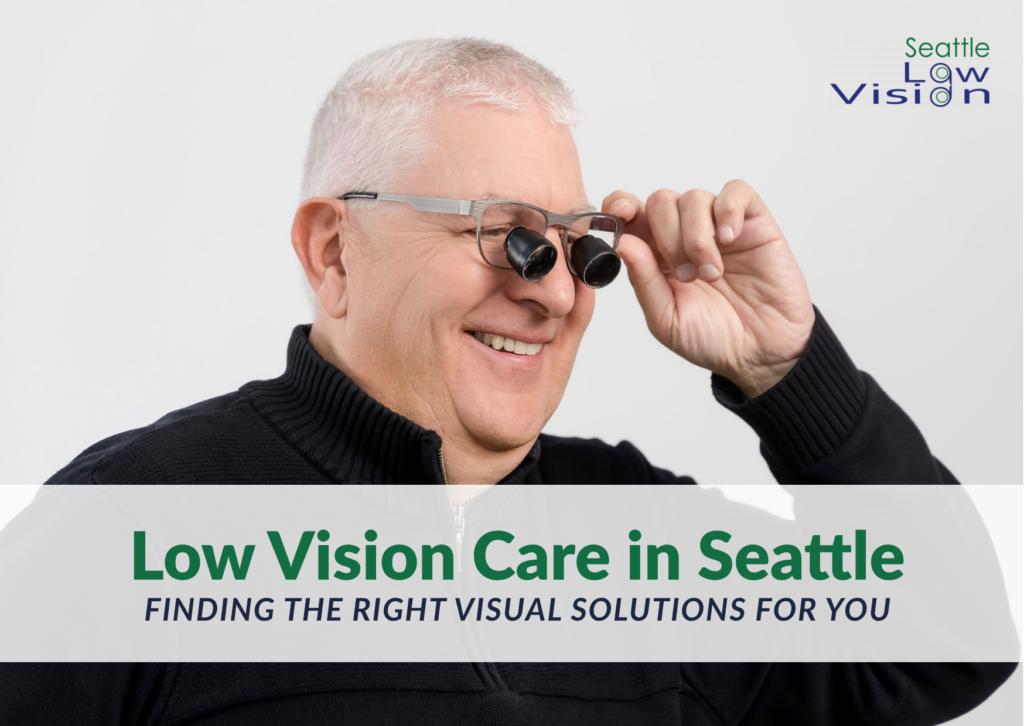
Distance vision is especially challenging for some of my patients, particularly those with macular degeneration. You may be able to tell that something is there but struggle to make out enough detail to identify it- a street sign, a presentation screen, or a face across the room. For these situations, I sometimes discuss a bioptic telescope: a small telescopic optical system built into or mounted above specialized glasses that provides additional magnification for specific distance-viewing tasks. Rather than looking through it continuously, you’ll wear your regular glasses day to day and use the telescope only when you need that extra reach, like reading a sign, watching a scoreboard, or picking out a detail you couldn’t otherwise see.
I’ll be honest with you — bioptic telescopes aren’t appropriate for everyone. Their usefulness depends on your remaining vision, your eye condition, your visual goals, and your ability to use the system effectively. As your low vision specialist, I can help you figure out whether this type of solution makes sense for your situation.
Low Vision Care Isn’t Just About Magnification
One of the most common misconceptions I hear in my Seattle practice is that the goal of low vision care is simply to find the strongest magnification possible. That’s not it at all.
My goal is to find the right visual solution for the task in front of you.
One patient may benefit from specialized low vision glasses for reading. Another may benefit from a bioptic telescope for specific distance-viewing activities. Someone else may do best with electronic magnification, improved lighting, increased contrast, environmental modifications, or a combination of several strategies working together.
This is why I treat every case individually. I never start with the question, “How much magnification do you need?” Instead, I ask, “What are you trying to see, and what is the most effective way to help you see it?”
How I Fit Into Your Eye Care Team
Seeing me does not mean replacing your ophthalmologist, retina specialist, optometrist, or other eye care providers. Each of us serves a different purpose, and I think it helps to see how the pieces fit together.
Your medical eye specialists focus on diagnosing and treating or managing the condition affecting your eyes or visual system whether that’s macular degeneration, glaucoma, or another diagnosis. Your primary eye care provider focuses on ongoing eye health, routine examinations, and vision correction. I focus on maximizing the functional use of the vision you have and identifying practical visual solutions as well as help you develop the strategies and skills to put those solutions to work in your everyday life.
Together, we address two important parts of vision loss: the health of your visual system, and how you actually function day to day.
You Don’t Have to Wait for Vision Loss to Become Severe
Another misconception I run into often is that low vision care is only for people who have very little vision left. That simply isn’t true.
If changes in your vision are making it harder to read, work, use a computer, recognize faces, or enjoy your usual activities, it’s worth finding out whether low vision care could help, regardless of how much vision you still have.
I see people at every stage of vision loss, including many in the early stages of macular degeneration who simply want to stay ahead of the challenges they know are coming.
You also don’t need to wait until every medical treatment option has been exhausted. Low vision care can work alongside your existing medical eye care. Your ophthalmologist, optometrist, or retina specialist can continue addressing your eye health while I focus on your functional vision needs- at the same time, not one after the other.
What If Your Vision Can’t Be Fully Corrected?
When glasses, contact lenses, medication, or surgery can’t fully restore your vision, it’s easy to feel like you’ve run out of options. I hear this from people all the time, especially those living with advanced macular degeneration.
But treating an eye condition and helping someone make better use of their remaining vision are two very different things. Even when vision loss can’t be reversed, there are often ways to make certain activities easier.
Depending on your needs, I may recommend specialized glasses, telescopic systems, electronic devices, lighting adjustments, contrast strategies, or rehabilitation, sometimes all working together. This is exactly why low vision care is such an important addition to your overall eye care plan.
Instead of asking only, “Can my vision be fixed?” I’d encourage you to also ask, “What can I do with the vision I have?” That question is often the one that opens the door to real, practical possibilities.
Take the Next Step With Low Vision Care in Seattle
If vision loss is making everyday activities more difficult, I’d encourage you to talk with me about your options. In fact, I offer a free telephone consultation. At Seattle Low Vision, I take the time to understand your unique visual challenges and goals so we can explore solutions that help you see more comfortably and live more independently, whether your vision loss is from macular degeneration or another condition.
My goal is never to replace your eye care team. It’s to complement it by focusing on how you can make the most of the vision you have.
Whether that means exploring low vision glasses, bioptic telescopes, magnification, technology, lighting, or contrast strategies, the first step is simply understanding what you’re trying to see and what’s currently getting in the way.
You may not be able to change the eye condition causing your vision loss. But together, we may be able to change how you use the vision you have.
Call Seattle Low Vision at 425-823-2020 for your free low vision phone consultation today to learn more about low vision care and find out whether a comprehensive low vision evaluation is right for you.